Everyone Loves “Hire Local” Until They See What It Actually Costs
$26 an hour sounds manageable. Until $26 an hour isn’t actually $26 an hour.
Hiring locally feels like the obvious choice.
Find someone good. Pay the wage. Get the work done.
Simple.
Except Australian businesses know there’s a rather inconvenient part hiding behind that hourly rate:
The hourly rate is only the beginning.
Once you start adding the real costs of employing someone, including superannuation, leave entitlements, recruitment, onboarding, equipment, training, management time and everything else required to put a productive person in that seat, suddenly that innocent looking hourly figure starts behaving very differently.
And that’s before you’ve made a single dollar from the hire.
The $26 Problem
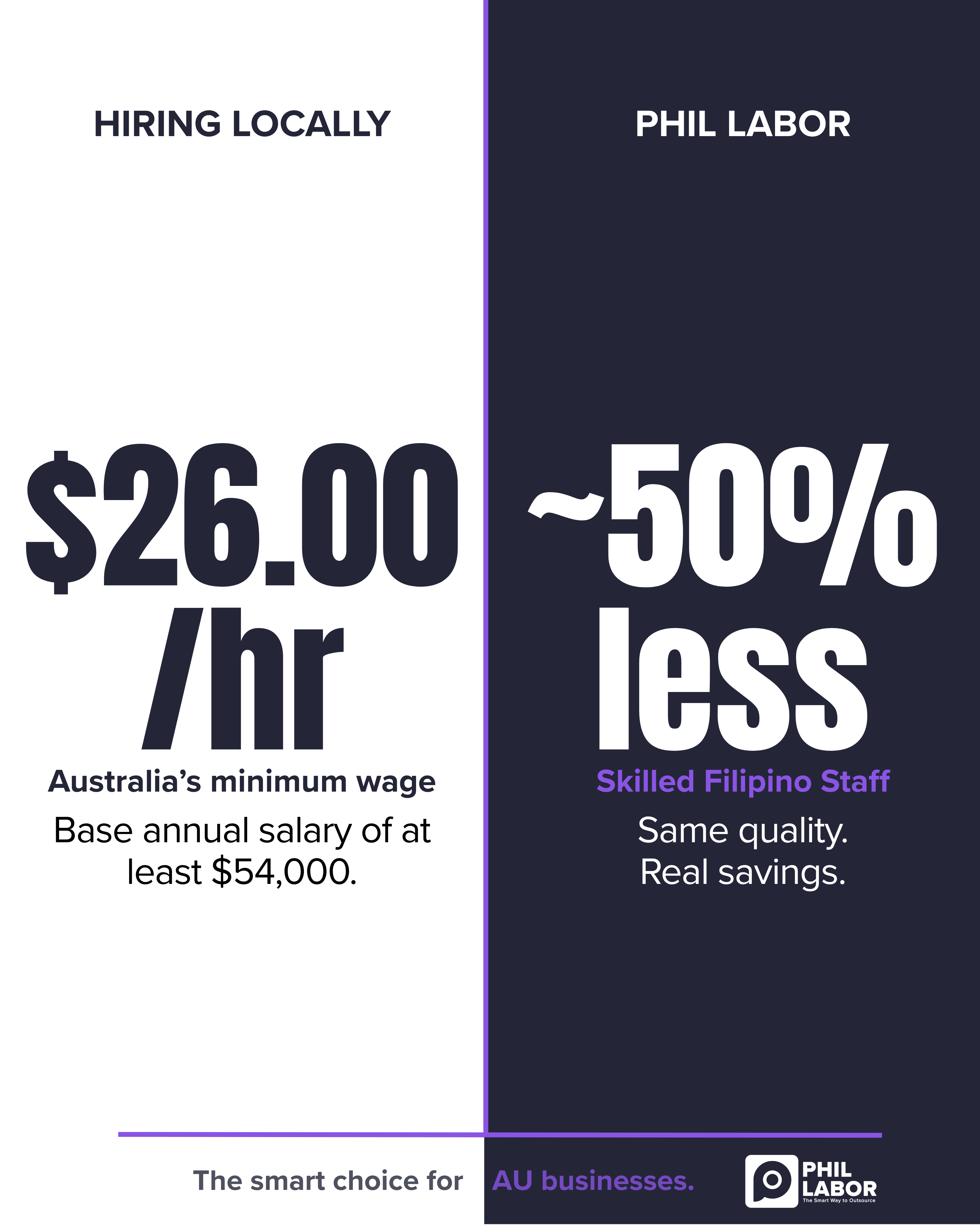
Let’s use the number in the graphic.
At $26 per hour, a full time employee working 40 hours a week represents roughly $54,000 in base annual wages alone.
And that’s the important word: Base.
Not total.
Your business doesn’t get to stop calculating at salary.
Depending on the employment arrangement, there may also be superannuation, paid leave, recruitment expenses, equipment, software, workspace, training and the internal time required to manage the entire process.
Suddenly: “We’re hiring someone for $26 an hour.” starts sounding suspiciously like: “We’re making a fairly significant annual investment.”
Because you are.
Now Here’s Where Offshore Staffing Gets Interesting
What if the question wasn’t: “How do we avoid hiring?”
But instead: “Does every role in this business actually need to be hired locally?”
That’s a very different conversation.
Customer service. Administration. Bookkeeping. Sales support. Marketing. Technical support.
There are plenty of business functions that can be handled effectively by skilled Filipino professionals without requiring another local desk, another local recruitment cycle and the same local employment cost structure.
And that’s where Phil Labor enters the chat.
Around 50% Less Doesn’t Mean 50% Less Person
This is probably the biggest misconception worth killing off.
Lower labour cost does not automatically mean lower quality talent.
The economics between Australia and the Philippines are different.
That’s the point.
Phil Labor helps Australian businesses access skilled Filipino professionals at a significantly lower staffing cost than many comparable local hires.
Potentially around 50% less, depending on the role and arrangement.
But the objective isn’t to find the cheapest human being with an internet connection.
Please don’t do that.
The objective is to find someone capable of doing the job, put the right systems and management around them, and create a staffing model that makes commercial sense.
Same business problem. Different hiring model. Very different cost structure.
“But Surely Local Is Better?”
Sometimes it is.
There are roles that absolutely should be local.
If someone needs to physically interact with customers, operate from your premises, perform hands on work or fulfil responsibilities that genuinely require them to be in Australia, offshore staffing obviously isn’t going to teleport them into your office.
We’re good. We’re not that good.
But plenty of modern roles already happen through a computer.
Your team is emailing. Updating a CRM. Answering customer enquiries. Preparing reports. Processing information. Managing calendars. Creating content. Following up leads. Updating systems. Troubleshooting technical issues.
If the work already happens digitally, geography becomes a much more interesting question.
The Real Question Is What You’re Paying For
Business owners sometimes compare: Australian hourly wage vs offshore hourly cost.
That’s useful.
But there’s a bigger comparison.
What are you actually buying?
If a lower cost staffing model allows you to add customer support sooner, clear an administrative backlog, improve response times, keep your CRM updated or finally remove repetitive work from senior staff, the saving isn’t just the difference between two hourly rates.
It’s what your existing team can do with the capacity they get back.
That’s where the maths gets interesting.
Cheap Hiring Can Be Extremely Expensive
There’s an important warning here.
Offshore staffing isn’t automatically good staffing.
Hire purely on price and you can end up paying for it through poor communication, inconsistent work, constant replacement, weak management and the horrifying experience of explaining the same process for the seventeenth time.
Congratulations. You saved money and somehow created another full time job for yourself.
That’s not the goal.
Cost efficiency only matters when the person can actually perform.
That’s why recruitment, vetting, onboarding, management and ongoing support matter.
Phil Labor’s model isn’t simply: “Here’s somebody cheaper. Good luck.”
It’s about helping businesses find suitable Filipino professionals and supporting the employment relationship with Australian led management.
Because saving money on a bad hire isn’t saving money.
Maybe Your Business Doesn’t Need Another $54,000+ Commitment
This is where business owners should get slightly uncomfortable.
How many tasks are currently sitting with expensive local staff simply because that’s how you’ve always done it?
How much of your own week is being spent on work someone else could handle?
How long have you delayed hiring because another local salary feels too expensive?
And how much growth are you sacrificing while you wait?
Sometimes the choice isn’t: Local employee vs offshore employee.
Sometimes it’s: Get support now vs keep doing everything yourself for another year.
That second option has a cost too.
It just doesn’t appear neatly on your payroll report.
Before You Hire Locally Again, Do the Whole Calculation
Don’t look at the hourly wage.
Look at the actual employment cost.
Then look at the role.
Which responsibilities genuinely require someone locally?
Which can be performed remotely?
What level of experience do you need?
What would happen if you could build that capacity at around half the labour cost?
You may still decide local hiring is right.
Great.
But at least you’re making the decision after seeing the whole picture.
Because “this is how we’ve always hired” is a surprisingly expensive business strategy.
The Smart Choice Isn’t “Cheapest.” It’s Smarter.
Phil Labor helps Australian businesses build offshore teams with skilled Filipino professionals, supported through Australian led management.
The goal isn’t to replace every local employee.
It’s to stop paying local market costs for every single role when you don’t have to.
Same quality expectations. A smarter staffing structure. Real savings.
And perhaps fewer moments staring at payroll wondering how $26 an hour became that number.
PHIL LABOR | THE SMART WAY TO OUTSOURCE